PR / MarketingCamp Sayre has quickly become the center point for Scouting in New England. With over 15,000 campers per year + the home to multiple swim teams and recently featured in the Boston Sunday Globe. Our 100 acres boasts great and exciting programs year round for boys, girls, families, school groups and corporations! Check out last weeks Sunday Globe Feature. (South and West)DevelopmentSpecial thanks to some recent very generous donors!· Amica Insurance $35,000· Yawkey Foundation $25,000 to help support and grow the Urban Youth Scout Reach Program· Steve Barnes pledged $100,000 to our overall Camp Sayre initiative which supports capital projects and urban youth.· Also, thanks to our new partner NVBots for their Science donation of a 3D printer!ProgramScouting's Outdoor Adventure on the River (S.O.A.R.) is back and being planned For October 2016! Check out the video from the last Guinness book record breaking S.O.A.R. event!Merit Badge at Harvard University continues to grow (standing room only!) and provide GREAT program for Scouts across New England!Merger with Boston Minuteman and Yankee Clipper BSAAs the merger date (June 30, 2015) approaches it becomes clear that our emphasis on transparency and "over communication," as well as the focus on developing a merger that Helps Scouting Thrive in Every Community has made a significant impact. Typically, mergers are filled with fear and failure. Ours certainly had those elements at the beginning but I believe it is being rapidly replaced with optimism and enthusiasm. More details to follow….
Sunday, March 22, 2015
Quick March update


Monday, March 2, 2015
Listening Sessions "Complete"
Chapter One: The Listening
Sessions
What can be
done to help Scouting thrive in your community?
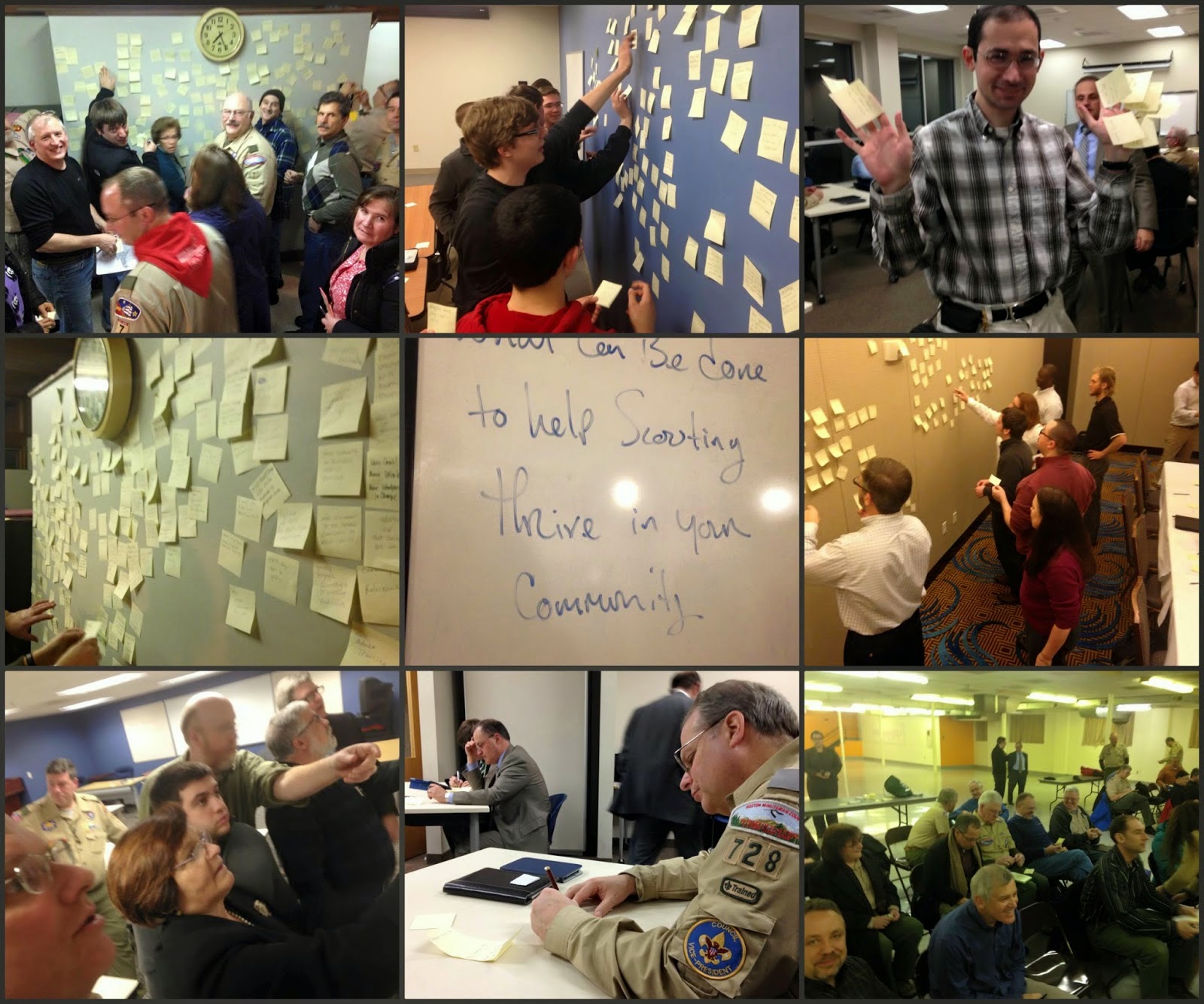
Throughout the
exercise we encouraged everyone "not to worry" if your idea doesn't
seem to resonate with the folks in the room, it's larger exercise and your idea
(or priority) will find it's way into "Chapter 2.
Chapter Two:
The Committee Work
An example of
how this feedback is used and where your idea goes from here
Prior to the listening sessions we took the liberty to
create seven primary committees. Those committees are called the joint
strategic committees. The categories we came up with in the listening
sessions will fall into those seven joint strategic committees. (check out
the collaborative
web page for additional details) As an example during several
sessions the category of "online," or "technology" or
"systems" were created. The folks who attended those
sessions believed technology and internal communication solutions would
"help Scouting thrive in our communities." We have reviewed every
single post it note and created a sub category under customer service. It
falls under customer service because the majority of the
"Technology" post it notes have a customer service component to
them.
The Systems subcommittee
will receive all those post-it notes as well as the annual costs from both
councils for technology, and any post camp and/or post program evaluations that
mention technology. They will also be encouraged to do research into
alternative software solutions.

Online /
Technology / Systems envelope with post it notes highlighted
The natural outcome of all this categorizing and
prioritizing is discovering an ultimate a "winner." As if by
focusing on the ultimate winner we could solve all Scouting's issues. But
common sense (and all the dialogue throughout every session) showcases that
looking for the one solution, won't really solve anything. Because all these
items are so interconnected. If we could wave a magic wand and tomorrow solve
all our customer service problems would Scouting then thrive in all our
communities? Of course NOT. Without the adequate funding wouldn't those
customer service solutions be short lived? How can we say we solve customer
service problems if our facilities are falling apart? If we don't solve our
governance short comings won't we just make the same mistakes
again?
It's clear that each category is directly connected to each other category. That's why our collective strategy is so critical to this process.
How we build our collective strategy
We'll stay with systems and customer service as our running example. Customer service turned out to be the second highest priority. (a close second to youth experience / program) Admittedly, it's a pretty broad category and there are a lot of ways to fix and improve our customer service. However, customer service through technology is clearly important one. So, in April the systems committee will propose recommendations in coordination with the joint customer service committee to the merger oversight committee.Those solutions will likely impact other aspects of the plan, cost of technology, expertise, hardware upgrades, marketing etc. The Merger oversight committee will work with all related committees to reconcile proposals and draft the final plan.
In early May those recommendations
will come back to the Scouting community through a series of open forum
meetings. During that time the proposed answers will be placed in a timeline.
The timeline will allow for all or most ideas to be realized, the only variable
is when.
Chapter Three: The Collective
Plan to help Scouting thrive.
Final adjustments may be made at
that time, and in June the entire Scouting community will be our collective
aware of how we choose to answer the question "What can be done to help
Scouting thrive in your community?"
How you can help
Click here and Enter you name, e-mail and choose which
committee you interests you. Each co-chair and sub committee will
need participants. We are going to keep all committees to about 8 (a patrol
and manageable size). The committee chairs will be looking for people
with specific skills for certain committee - to stick with our example - a few
IT and web based professionals will be needed for the Systems Committee. If
your first choice committee is full, you'll be free to contact others and the
committees will work together to take you up on your willingness to help.
Lastly, this process is designed to give voice to as many volunteers as
possible. the Joint Committee Chairs will discourage any one Scouter from
serving on multiple committees.
Monday, February 2, 2015
Revitalize Scouting through Social Media or Program?
Every time we brainstorm about how to revitalize Scouting comments about social media and marketing are bound to come up. But, try as we might, it's difficult to gain traction and use social media to attract youth and families to Scouting. There are a BUNCH of reasons (or theories) as to why it doesn't seem to work for us - scouting in general. I often try to find things that DO work and listen to the nuances as to how Scouting works in some instances yet not all instances.
Here are a few of my observations / hypothesis
Clearly, a handful of families join local packs and troops when the families get excited about scouting because they notice a picture of a friend enjoying a camping trip, or a pinewood derby. It often sounds like "I had no idea you were involved in scouting, tell me more about it" In that instance social media enhances the reach of parents and the relationship among parents is really at the core of the resulting registration.
As the guy who is often credited with creating BEaSCOUT.org (I was lucky enough to be one of the leaders in that great collaborative project) I have watched the usefulness of that site and the enthusiasm for that site ebb and flow over the past 7 years. It clearly connects about one hundred families each year to Scouting in our council - it's difficult to know weather these families would have joined with or without access to the local pack info. (BEaSCOUT generates about two leads per pack per year)
In the past couple weeks we did find a few direct ties from social media to people attending camp! This cub scout mom below follows my face book and called on Friday, she was seeking a great afternoon of outdoor fun for her two cub scout sons and her kindergarten daughter. As a den leader she brought the den to camp a couple years ago - but she didn't realize she could just attend, without the pack or the den. My favorite part of her post is that her daughter and wolf cub learned to skate on Saturday at Camp Sayre!

In similar experience this fledgling venture crew went ice climbing last week. When a friend of one of the venturers saw these picture on instagram she asked her friend all about it, the next thing we knew the girl and four other friends signed up for ice climbing again, the very next weekend! doubling the size and interest in the new Venture Crew.

Here are a few of my observations / hypothesis
Clearly, a handful of families join local packs and troops when the families get excited about scouting because they notice a picture of a friend enjoying a camping trip, or a pinewood derby. It often sounds like "I had no idea you were involved in scouting, tell me more about it" In that instance social media enhances the reach of parents and the relationship among parents is really at the core of the resulting registration.
As the guy who is often credited with creating BEaSCOUT.org (I was lucky enough to be one of the leaders in that great collaborative project) I have watched the usefulness of that site and the enthusiasm for that site ebb and flow over the past 7 years. It clearly connects about one hundred families each year to Scouting in our council - it's difficult to know weather these families would have joined with or without access to the local pack info. (BEaSCOUT generates about two leads per pack per year)
In the past couple weeks we did find a few direct ties from social media to people attending camp! This cub scout mom below follows my face book and called on Friday, she was seeking a great afternoon of outdoor fun for her two cub scout sons and her kindergarten daughter. As a den leader she brought the den to camp a couple years ago - but she didn't realize she could just attend, without the pack or the den. My favorite part of her post is that her daughter and wolf cub learned to skate on Saturday at Camp Sayre!
In similar experience this fledgling venture crew went ice climbing last week. When a friend of one of the venturers saw these picture on instagram she asked her friend all about it, the next thing we knew the girl and four other friends signed up for ice climbing again, the very next weekend! doubling the size and interest in the new Venture Crew.
It can clearly work! We can grow Scouting through program opportunities. And we (the council and Camp Sayre) continue to have a lot to learn about how to reach outside of our classic methods and encourage deeper engagement. It's encouraging to know that we are on the right track ....
Oh, and both the Mom and her cub scout family and the venturing girls come from out of council.
Please share your thoughts, observations and comments about growing Scouting through program or the use of social media to grow scouting.
Sunday, January 11, 2015
Full story of our debt
Just want to
take a moment and tell the full story of our debt.
The final
piece of the debt elimination was a conservation easement on 450 acres at Storer
Scout Reservation. All those acres create a wilderness buffer for the 250
internal acres. The 250 internal acres (Adams Pond Camp and Wild Goose Camp)
are unencumbered and restriction free, these 250 acres contain all the shore
line around Adams pond and most of the shore line at Wild Goose. Scouts can
still hike, mountain bike, horseback ride and otherwise participate in outdoor
pursuits within the conservation area. The council can still log within the
conservation area.

Previous
aspects of the debt elimination include the conservation of Parker Mountain,
the sale of unrestricted investments, the sale of 30 acres at camp Massasoit
and the sale of the Jamaica Plain office. As you can see, the council made
every effort to minimize impact to youth in the decisions around debt
elimination. The council still has the controlling interest in all four
original properties.
The
long-term debt was originally comprised of $5.3 million. The $8 million number
includes interest and budget shortfalls caused by the extreme debt over the ten
year period.
The debt
certainly hand cuffed council operations over the past decade in several ways.
The two most notable are staffing and cash flow. The middle years 09 and 10
were clearly the tightest (and the smallest). The 22,000 square-foot Egan
Center was reduced to 7,000 square-foot of usable space, and the full-time
staff was reduced to six people for about half a year.
The cash
flow concerns remained a problem throughout the debt period. While the council
has brought in more money then it spent on operating annual basis for the past five
years that does not include the capital fund. The capital fund is generally viewed
through a longer-term lens, during that 10 year period the capital fund would
typically endure significant debt in between periods of large cash deposits.
The recent conservation easement is a perfect example it took 18 months from
start to finish and brought in $619,000 during those 18 months the operating cash
was burdened to generate the money required to pay the mortgage, the end result
is the $619,000 goes to the principal and pays back some of the cash requirements
extended over the past 18 months.
Additionally,
projects like logging at Storer or annual surpluses would go immediately to
debt reduction - so those occasional cash infusions could never be used to
"catch our breath" or invest in the future.
On the other
hand, we did dramatically increase the money generated in non-debt capital
funds over the past few years. And we have worked hard to ensure that all the
funds raised for camp improvements have been spent in camp improvements - not
debt elimination. That's why both primary camps are looking better each day.
So, every
NEW dollar we raised in the past few years weather operating or capital went to
program delivery, administrative improvements, camp enhancements, marketing and
communication or some other annual benefit to Scouting. And we challenged
ourselves to pay for the debt elimination without losing the controlling
interest in the camps. It will take another year or two for the cash flow to
actually "self correct" but it will improve every day. (As an example:
for the first time the 2015 logging operation at Storer will be able to be used
toward camp improvements).
So the mortgage
is gone! We'll post a year-end Financial Statement when it's complete. And any
short term loans or revolving credit concerns are down to the lowest amount
since 2011. And the operating budget - the amount raised and spent in support
of Scouting each year is up over $2.5 million for the third year in a row. (It
was down to $1.8 million during our thinnest years)
Finally it's
our hope and belief that Scouts can feel this difference - none of this matters
until it makes a positive impact for a Scout. While Scouts and families don't
see the budget, and likely don't care, the differences between then and now begin
with someone to answer the phone, camp improvements, higher visibility, and program!
Program! And more program offerings! I'm sure anyone who was an active leader
during the thinnest years could apply the council to the "smell test"
and agree things are clearly looking much better. And, one thing we are very
proud of - the unseen stuff is also greatly improved. The unseen stuff is the
infrastructure at the properties (these improvements are much more that a
"pretty coat of paint") the governance and the business practices are
all stronger and getting better right alongside the visual improvements.
Whew! That's
the whole story of debt elimination. The debt is gone but the job is far from
done - we will continue to improve each day. For everyone who was with Scouting
throughout these years THANKS FOR YOUR SUPPORT! Everyone who has joined us
recently .... You are joining a rapidly growing and great youth development
program - WELCOME!
Subscribe to:
Posts (Atom)